
Article: Linerless Print and Apply Labeling Hitting Its Stride
September 29, 2026
Catherine Hornsby
Sustainability, Efficiency, and Throughput
Although linerless labeling technology has existed for a while, U.S. adoption of automated linerless labeling has been slower than in the EU. Until recently, linerless labeling was used mainly for retail desktop printers, weigh scales, and baggage tags rather than fulfillment and other automated processes.
Now, with large CPGs, ecommerce operations, warehousing, and retail outlets focusing more heavily on environmental impact as part of ESG scoring and international regulations, automated linerless labeling is finally hitting its stride. As zero-waste distribution centers and energy-reduction goals become more common in corporate responsibility initiatives, companies are looking for technologies, like linerless print-and-apply systems, to help meet those goals. Automated linerless print-and-apply systems bring that capability directly into warehouses, distribution centers, and production lines, keeping pace with processing demands while eliminating waste.
Now, with large CPGs, ecommerce operations, warehousing, and retail outlets focusing more heavily on environmental impact as part of ESG scoring and international regulations, automated linerless labeling is finally hitting its stride. As zero-waste distribution centers and energy-reduction goals become more common in corporate responsibility initiatives, companies are looking for technologies, like linerless print-and-apply systems, to help meet those goals. Automated linerless print-and-apply systems bring that capability directly into warehouses, distribution centers, and production lines, keeping pace with processing demands while eliminating waste.
Environmental Benefits
One of the most significant environmental benefits of linerless labeling is the reduction of label liner in the waste stream. As the name implies, linerless labeling eliminates the label backing, or liner, entirely. Label liner is difficult to recycle due to the silicone coating used to release the adhesive, so it typically ends up in landfills or incinerators. According to GoLabeling, more than 400,000 tons of label liner is disposed of each year¹. This challenge is precisely why linerless labeling technology was developed.Linerless labeling also eliminates used thermal ribbons. By utilizing direct thermal printing, which activates a color change on the label surface rather than transferring ink from a ribbon, linerless systems keep both the synthetic ribbon carrier and residual ink out of the landfill. This not only reduces waste but also improves data security, since information printed on a label can often be read on a spent thermal ribbon.
Through the implementation of automated linerless print-and-apply systems, companies can immediately reduce the waste streams generated by traditional labeling. It is estimated that eliminating both the label liner and thermal ribbon can reduce a company’s environmental footprint by up to 30%¹.
Additional Benefits
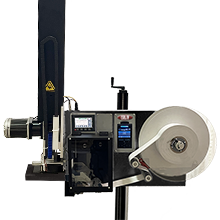
There are additional benefits to automated linerless print-and-apply systems:1. Energy Savings: Systems with full electric application methods, such as FOX IV’s linerless print-and-apply solutions, reduce energy costs by using electricity more efficiently. Pneumatic systems are historically inefficient—up to 90% of energy is lost through heat, leaks, and pressure drops². Only 10–15% of the electricity used to produce compressed air is converted into usable work³, making pneumatic systems more expensive to operate.
2. More Labels Per Roll, Less Downtime: Without a label liner and gap between labels, the
overall thickness of the label material is reduced and material is used more efficiently,
allowing more labels to be wound onto each roll. Companies can see up to 50% more
labels per roll compared to conventional labels¹. More labels per roll means longer
production runs between roll changes and less downtime.
3. Flexibility: All-electric labeling systems are easier to install and move between lines
because they do not require a factory air drop. Print-and-apply systems can be placed
anywhere there is data and electrical access and relocated as needed.
4. Speed: Automated print-and-apply systems are 6–9X faster than hand labeling,
depending on label size and application method. By automating labeling, processing
speeds increase and bottlenecks are significantly reduced.
As more companies look for practical ways to meet sustainability goals, reduce waste, and
streamline operations, linerless print-and-apply systems are becoming an easy, meaningful step forward. The combination of zero-waste labeling, energy-efficient electric application, longer roll lengths, flexible installation, and dramatically faster throughput makes linerless technology not only environmentally responsible but operationally smart. With automated linerless labeling gaining momentum in U.S. fulfillment and distribution, businesses now have a solution that supports ESG initiatives while keeping pace with modern processing demands. It’s a win for efficiency, a win for sustainability, and a clear path toward a cleaner, more productive future.
1 https://golabeling.com/en/linerless-labels.html; 2 https://inzonex.co.uk/ai/reports/state-of-compressed-air-efficiency-2026; 3 https://wifitalents.com/compressed-air-industry-statistics